
I went to Cataloochee Valley hoping to see an elk or two. Instead, we pulled up to a field where a bull was herding at least 12 cows, and two calves still had their spots.
I could have watched them all night. If you’re spending time in the North Carolina mountains, this is the day I’d plan everything else around, and here’s everything you need to make it a good one.

I traveled with media colleagues on a media trip hosted by Visit Haywood County, and many of the experiences in this article were complimentary. All opinions are my own.
Some links in this article are affiliate links that may earn me a commission if you purchase through them.
How Cataloochee Got Its Elk Back
Elk once roamed these mountains, but they were gone from North Carolina by the late 1700s. In 2001, the National Park Service brought 25 elk to Cataloochee Valley to see if they could make a home here again.
They did. Around 300 elk now live in and around the park, and Cataloochee is still the best place to see them.
Knowing that history makes watching them feel even more special. Every elk in that field is part of a comeback that almost didn’t happen.

Getting to Cataloochee Valley
Cataloochee sits in a remote corner of Great Smoky Mountains National Park, and there are two main ways in. Both end up on Cove Creek Road, which winds over the mountain and down into the valley.
From I-40, take exit 20 toward Maggie Valley and turn right almost immediately onto Cove Creek Road. This is the way we went, coming from Canton.
From Maggie Valley, take US-276 (Jonathan Creek Road) north about 6 miles and turn left onto Cove Creek Road. It’s the last left before you reach I-40.
| Starting point | Best route | About how long to the valley |
|---|---|---|
| Maggie Valley | US-276 north to Cove Creek Road | 45 minutes |
| Lake Junaluska | US-19 to US-276 north to Cove Creek Road | 50 minutes |
| Waynesville | US-19 to US-276 north to Cove Creek Road | 50 minutes to an hour |
| Canton or Asheville | I-40 west to exit 20 | Canton 50 minutes, Asheville about an hour and 15 minutes |
Those drive times sound longer than you’d expect for the miles, and that’s because the road winds and twists, so you have to go extra slow. It took us more than 45 minutes, and every bit of that was worth it.
What the Drive In Is Really Like
Cove Creek Road starts out paved, then turns to gravel for a good long stretch as it climbs over the mountain. I didn’t expect that, and I was even more surprised when it turned back to pavement as we dropped down toward the valley.
The views are gorgeous, but the road is narrow. Around the curves, you can’t see much of what’s coming, so you have to go slowly and hope anyone heading the other way is doing the same.
Steep drop-offs have no guardrails, and sometimes one car has to stop or back up so another can pass, though thankfully we didn’t experience that. I wouldn’t want to drive it in the dark, in fog, or in heavy rain, so plan to leave the valley before sunset approaches.
The park also closes the road when there’s snow, so check the Great Smoky Mountains road closures page before you head out in winter.
Prep Before You Lose Cell Service
There’s no cell service in Cataloochee, and you lose it well before you reach the valley. Download an offline map and save the trail and building names you want to find before you leave town.
There’s also no gas, food, or store anywhere in the valley. Fill your tank and pack all your food and water before you turn onto Cove Creek Road.
You can drive through without paying, but you need a parking tag if you stop anywhere for more than 15 minutes. Daily tags are $5, weekly tags are $15, and annual tags are $40.
Buy your daily or weekly tag online through Recreation.gov and print it at home, since park staff won’t print it for you. You’ll also find stations near parking areas where you can purchase a pass. Set it face-up on the passenger side of your dashboard.
What’s Open in Cataloochee After Hurricane Helene
Cataloochee took some of the worst damage in the park from Hurricane Helene in 2024, and it’s still recovering. The road is open into the valley, but it’s closed to cars past Beech Grove School.
Park near the Palmer Creek Bridge by the school, where the road ends for cars, and walk the rest of the way to the Caldwell House, the Caldwell Barn, and the Rough Fork Trail. We walked about a mile on the closed road to reach the trailhead, and it’s uneven in spots with ruts and washouts, so wear decent shoes.
Most of the footbridges that crossed the streams washed away in the storm, and some trails have erosion damage. Check the park’s closures page right before your trip, since conditions change as repairs continue.
The Best Time of Day to See Elk
Go early in the morning or in the last few hours before sunset. Elk don’t sweat, so when it’s warm, they stay in the shade of the forest and come out into the fields to graze as it cools down.
We arrived a little after 5pm, and the herd was already out in the field near Palmer Chapel. We stayed until almost 6:30pm, and the elk were all still there when we had to leave for dinner reservations.

I would have stayed so much longer if we didn’t have to go. A midday visit on a warm day can come up empty, so plan your viewing around the edges of the day, knowing there’s plenty to do there the rest of the day or if the elk don’t cooperate.
When to See Elk in Cataloochee by Season
You can see elk in Cataloochee year-round, but each season has a different experience.
Spring Calving Season
Most calves are born from late May through June. Cows hide their newborns in the tall grass and can get protective, so this is a time to give the herd even more room.
Summer
Summer brings the longest days and the warmest afternoons, so early mornings and evenings really make a difference. By late summer, the calves are out with the herd, and the young ones still had visible spots when we visited in early October.
The Fall Rut
The rut, or breeding season, runs from September through October. Bulls bugle to challenge each other and gather cows, and it’s one of the most popular times to visit.
Bulls are much more aggressive during the rut, and the park closes the fields at Cataloochee to all visitors during this time. Watch from the road and near your car.
During the rut, you may also see volunteers from the Elk Bugle Corps helping with traffic and answering questions. We didn’t see them or hear any bugling on our visit, but I’d love to hear it next time.
Be aware that you are absolutely not allowed to bring your own devices to make bugling calls for safety reasons.
Winter
Winter is quieter in Cataloochee. The herd often retreats into the woods and may not show up in the fields for weeks at a time, and snow can close the road completely. If the roads are open, you can still hike down near the Palmer Creek Bridge to areas where you may spot them.
Watching the Herd
The herd we found was grazing in a field with no official parking, so cars pulled off the road to watch. One family ate dinner in the back of their pickup truck while the elk grazed.
The bull spent much of the last half of the time we were there herding his cows, pushing back any when he felt uncomfortable. The two calves with spots were pretty independent and eventually lay down in the grass for naps.

It was magical and majestic. I’ve seen a lot of wildlife on my travels, and this ranks right up there.
How Close You Can Get to the Elk
Stay at least 50 yards (150 feet) away from the elk, which is about half a football field. They’re wild animals and unpredictable, and a bull can weigh close to 1,000 pounds.
It’s illegal in the park to get close enough to disturb or displace an elk, no matter the distance. Breaking that federal rule can mean fines and even arrest.
We watched several people walk way too close to the herd, and they were lucky there were no incidents this time. Don’t be those people.
If an elk starts walking toward you, calmly back away and give it space. Don’t let it close the distance, and get back in your car if you can.
When you pull off to watch, get your car fully off the road. The road is narrow, and blocking it backs up traffic for everyone else.
How to Spend a Full Day in Cataloochee
Once you’ve made that drive, it’s worth staying a while. If I had a full day, here’s how I’d spend it.
- Get there early in the morning to watch the elk while it’s still cool.
- Head out on a hike once the herd drifts back into the woods.
- Stop for a picnic lunch. There aren’t picnic tables, but you can bring a blanket and spread it out in the fields if they’re open.
- Hike some more or explore the historic buildings.
- Head back to the fields in the late afternoon to find the elk again before you leave.
That plan keeps you in the valley during the two best windows for elk. It also gives you something great to do in the middle of the day, when the herd is hiding from the heat.
Hike Rough Fork Trail to the Steve Woody House
Rough Fork Trail is the hike we started, and it follows Rough Fork Creek through a lovely hardwood forest. The first mile to the Steve Woody House is a relatively easy walk on a wide trail.
We turned around before we reached the house because we knew where the elk were and wanted to get back to them and the babies. I don’t regret it one bit, but the creek was so pretty that I’d love to go back and finish it.

The house itself was built around 1880 and was once the center of a working homestead. Past it, the trail keeps climbing all the way to Polls Gap, about 12.6 miles round trip, and it gets much more challenging, though avid hikers can handle it easily.
Right now, you park at the Palmer Creek Bridge and walk about a mile down the closed road just to reach the trailhead. That makes the round trip to the Woody House closer to 4 miles, so plan for extra time.
Dogs aren’t allowed on any of the trails in Cataloochee Valley, so this one isn’t pet-friendly. Leave Fido at home for this day. Many other trails in the area are pet-friendly, so hike with your pup there instead.
Explore the Historic Buildings
Long before Cataloochee was part of the national park, it was a farming community with more than a thousand people. Nine buildings still stand from those days, from homes to a school, a chapel, and a barn.
We visited Palmer Chapel and Beech Grove School, and it’s eye-opening to see how different life was here a hundred-plus years ago. You can look inside the chapel and imagine the whole valley filing in for Sunday services.

The schoolhouse is not the single-room schoolhouse you imagine from old movies, but two rooms. They’re relatively stark, but they include the former chalkboard and some desks, and they give you a sense of how different the education system was back then.
Five of the buildings sit along the main road, including the Palmer House, the chapel, the school, the Hiram Caldwell House, and the Caldwell Barn. The other four are along the Little Cataloochee Trail.
The Caldwell Barn was damaged in Helene, so admire it from outside and don’t go in.
Pack a Picnic
There’s nowhere to buy food in Cataloochee, so pack a picnic and make an afternoon of it. We had dinner reservations and didn’t picnic, but we saw people who did.
The only picnic tables are at the campground (which isn’t where you want to spend your time), so bring a blanket to spread out instead. Pack out everything you bring in, since there aren’t trash cans everywhere you’ll want to eat.
You’ll find wheelchair-accessible restrooms near the Palmer House along the main road. Plan your stops around them, because there aren’t others along the way.
What to Do If the Elk Aren’t Out
Elk are wild, and some days they just don’t cooperate. Don’t give up on the day.
That’s the perfect time to hike Rough Fork Trail, explore the chapel and the school, or walk along Cataloochee Creek. Keep checking the fields as you go, since the herd can wander out at any time.
If you can, stay until the last couple of hours before sunset, because that’s when your odds are best. And if you’re staying nearby, the fields by the Oconaluftee Visitor Center near Cherokee are another good spot to look for elk.
What to Bring
These are the things that made our time in Cataloochee easier, plus what I’d add for a full day.
A monocular or binoculars makes a huge difference when the elk are 50 yards out or farther. I’m a Nocs monocular convert because it’s small enough for a pocket and so much faster to aim than binoculars.
On my Alaska cruise, I spotted bears with my monocular faster than my dad did with his binoculars, and I share more about it in my Alaska cruise packing list. It worked just as well on the elk, bringing them right up close while I stayed well back.

Small enough for a pocket and powerful enough to bring a grazing herd up close from 50 yards back. It’s easier to carry and faster to aim than binoculars.
You’ll want a daypack that holds water, snacks, layers, and a picnic blanket. Mine folds into its own pocket when I’m not using it, so it’s easy to toss in the car, but it holds everything I need for a full day.

A waterproof backpack that folds into its own pocket when you don’t need it. It holds water, snacks, layers, and a picnic blanket for a full day in the valley.
Mountain mornings and evenings get chilly fast, even when the afternoon was warm, so bring a layer you can add as the sun drops. Wear sturdy shoes, too, especially if you plan to walk the closed road or hike.
Round it out with plenty of water, sunscreen, bug spray, and a bag to pack out your trash. And don’t forget your printed parking tag and an offline map.
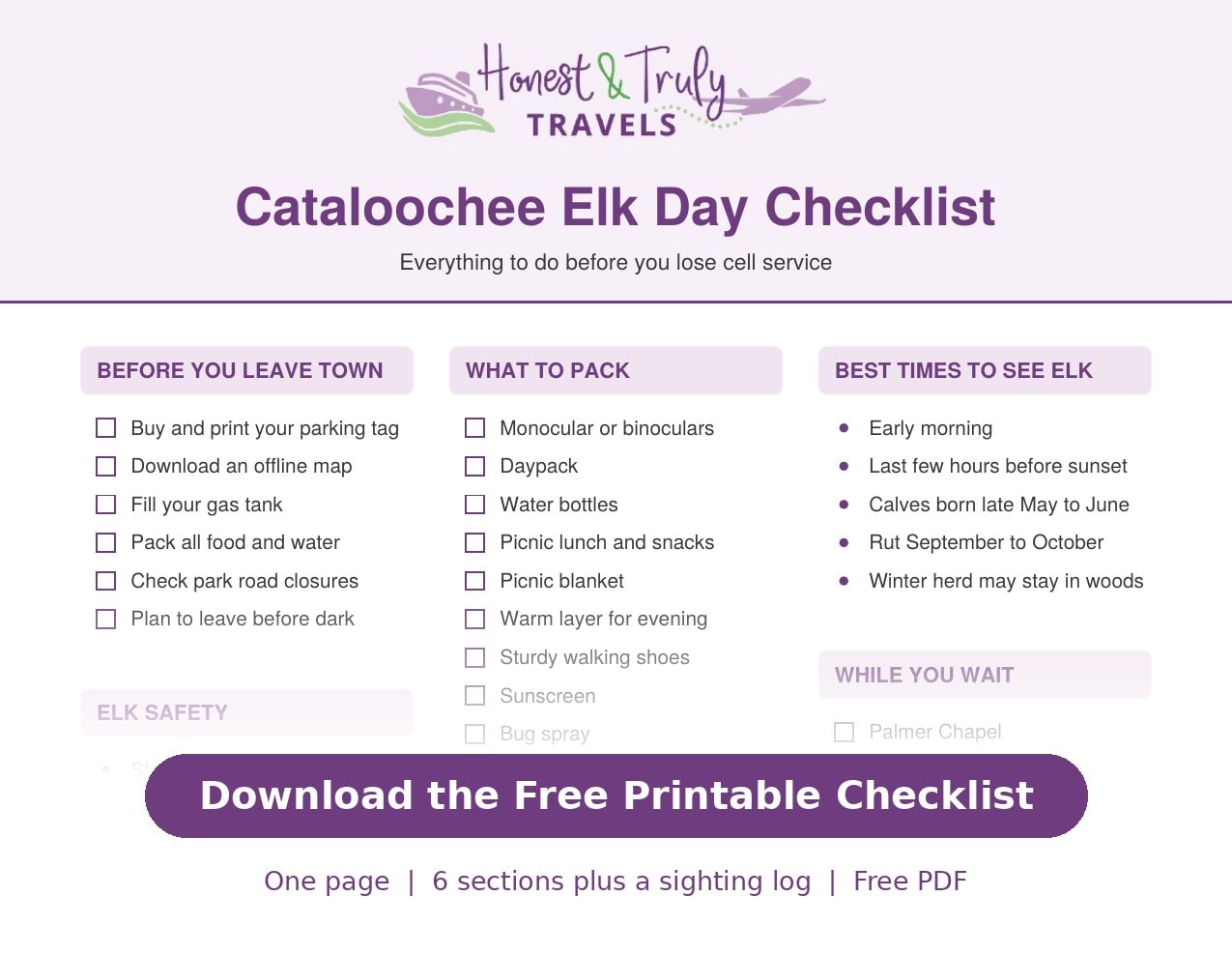
Free Printable Cataloochee Elk Day Checklist
Since you won’t have cell service once you’re in the valley, I put everything you need onto a one-page checklist. Print it before you go and keep it in the car.
Frequently Asked Questions
Do you need a reservation to visit Cataloochee Valley?
No. You don’t need a reservation, but you do need a parking tag if you stop anywhere for more than 15 minutes.
Is the road to Cataloochee paved?
Partly. Cove Creek Road has a long gravel section with narrow curves and steep drop-offs, then the road turns back to pavement as you get closer to the valley.
Can you see elk in Cataloochee year-round?
Yes, but your odds change with the season. Early morning and the hours before sunset are best all year, and the herd can disappear into the woods for weeks in winter.

How long should you spend in Cataloochee?
Plan on at least half a day, including the drive. If you want to hike and see the elk at both ends of the day, make it a full day.
Is Cataloochee good for kids?
Yes. Kids love watching the elk, and the first mile of Rough Fork Trail is a manageable walk, but keep them close and well back from the herd.
Can you bring dogs to Cataloochee?
Dogs can ride along and stay near your car, but they aren’t allowed on any of the trails in Cataloochee.
Where else can you see elk in North Carolina?
The fields by the Oconaluftee Visitor Center near Cherokee are a popular spot, and elk also show up in the Balsam Mountain area of the park.
Why Cataloochee Is Worth the Drive
The road in is slow, there’s no signal, and you have to plan ahead. That’s exactly why it feels so special once you’re there, completely disconnected and watching a herd of wild elk go about their evening in a quiet mountain valley.
Pair it with the rest of my North Carolina mountains guide to plan the other days of your trip. And if wildlife watching is your favorite part of travel, too, my guide to the animals you might spot in Patagonia is a whole other kind of magic.
I am a participant in the Amazon Services LLC Associates Program, an affiliate advertising program designed to provide a means for sites to earn advertising fees by advertising and linking to Amazon.com.